
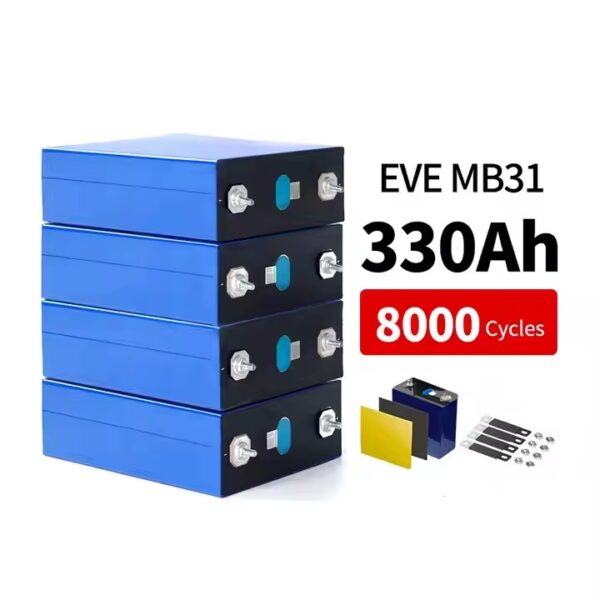
Choosing a Fast charge LiFePO4 battery requires more than comparing capacity or advertised charging speeds. You need to check the maximum charging current, nominal voltage, battery management requirements, and compatibility with your energy storage system. An unsuitable charging setup can limit performance or compromise battery safety.
The EVE MB31 LiFePO₄ battery offers a nominal capacity of 280Ah, a voltage of 3.2V, and an energy rating of 896Wh per cell. Its specified maximum charging current is 140A (0.5C), while the maximum discharge current is 280A (1C). These figures give you a practical starting point when evaluating a battery for residential energy storage, off-grid power systems, or custom battery packs. Jule PowerTech Co., Ltd. supplies lithium iron phosphate battery products and energy storage solutions for different customer requirements.
What Makes the EVE MB31 a Fast Charge LiFePO4 Battery Option?
Charging performance depends on the cell’s electrical specifications and the charging system working together. The EVE MB31 supports a maximum charging current of 140A according to the supplied product specifications. However, the actual charging time depends on the charging profile, starting state of charge, temperature, and applicable manufacturer limits.
Key EVE MB31 Battery Specifications
| Parameter | EVE MB31 specification |
|---|---|
| Battery chemistry | Lithium iron phosphate (LiFePO₄) |
| Nominal capacity | 280Ah |
| Nominal voltage | 3.2V |
| Rated energy | 896Wh |
| Charge voltage | 3.65V |
| Discharge cut-off voltage | 2.5V |
| Maximum charge current | 140A (0.5C) |
| Maximum discharge current | 280A (1C) |
These specifications describe an individual battery cell, not a complete 12V, 24V, or 48V battery pack. If you plan to build a battery system, you must also consider series and parallel configuration, compatible charging equipment, thermal management, and battery management system (BMS) settings.
How to Evaluate Fast-Charging Performance
A higher charging current can reduce charging time, but only when the cell and the entire system support that operating condition. Before selecting a high-capacity LiFePO₄ battery, review these factors.
1. Check the Maximum Charging Current
The MB31’s stated maximum charging current is 140A, equivalent to 0.5C for a 280Ah cell. Do not assume that every charger can continuously deliver this current under all conditions. Confirm the manufacturer’s recommended charging profile and operating limits before installation.
2. Match the Charger to the Battery
The specified charge voltage is 3.65V per cell. Your charger must follow the required voltage and current limits for the selected battery configuration. For a multi-cell battery pack, calculate the pack voltage from the series configuration and verify that the charger is compatible with the complete system.
3. Verify BMS and Temperature Protection
A suitable BMS helps monitor cell voltage, current, and temperature while providing protections configured for the battery system. Check that the BMS, wiring, connectors, and protective devices can handle the intended charging current. The product specifications supplied for this listing do not establish whether a particular BMS is integrated into the individual MB31 cell.
4. Confirm the Expected Charging Time
Charging time is not determined by capacity alone. It also depends on the actual current delivered, charging stages, starting state of charge, temperature, and current reduction near full charge. Ask your supplier for a verified charging curve if your application requires a defined charging window.
Where Can You Use a 280Ah LiFePO₄ Battery?
The EVE MB31 may be considered for battery systems that require high cell capacity and stable energy delivery. Potential applications include:
- Home energy storage: Store electricity for use with a compatible residential battery system.
- Off-grid solar systems: Support solar energy storage when the system design matches the cell voltage and capacity.
- Commercial backup power: Provide an energy storage building block for appropriately engineered backup systems.
- Custom battery packs: Serve as a cell option for integrators designing larger LiFePO₄ battery assemblies.
For electric vehicles, golf carts, and other mobile equipment, verify the required discharge profile, vibration resistance, thermal design, pack configuration, and relevant application-specific approvals before selecting the cell.

How to Select the Right Fast Charge LiFePO4 Battery
Follow these steps before requesting a quotation from Jule PowerTech:
- Define your application. Identify whether you need residential storage, off-grid solar power, backup power, or a custom battery pack.
- Calculate your energy requirement. Estimate daily consumption and required backup duration, then account for system efficiency and usable capacity.
- Confirm electrical compatibility. Match the cell configuration to your target pack voltage, charging current, and discharge requirements.
- Review safety and compliance. Request applicable test reports, certification documents, and transport documentation for your intended market. Do not assume certification without supporting records.
- Request a technical quotation. Provide your target voltage, capacity, charging time, operating temperature, and estimated order quantity so the supplier can assess the requirements.
Jule PowerTech was established in 2019 and has a team of 50 professionals. The company focuses on LiFePO₄ cells and battery packs, including 12V, 24V, and 48V products, as well as energy storage solutions. Its company profile also identifies a Los Angeles manufacturing and warehouse presence intended to support the US market. Confirm product availability, delivery arrangements, and the specific services available for your order directly with the company.
Frequently Asked Questions
1. How fast can the EVE MB31 charge?
The supplied specifications list a maximum charging current of 140A (0.5C). Actual charging time depends on the charging profile, starting state of charge, temperature, and manufacturer-approved limits. A verified charging curve is needed to establish a reliable charging-time estimate.
2. Is the EVE MB31 a 12V battery?
No. The listed MB31 is a 3.2V, 280Ah cell with 896Wh of rated energy. A 12V-class battery pack requires multiple cells connected in series and a compatible BMS and charger.
3. Can the EVE MB31 be used for home solar storage?
It may be suitable as a cell in a properly engineered solar storage battery system. You should verify the required pack voltage, usable capacity, BMS configuration, inverter compatibility, installation conditions, and applicable safety requirements before purchasing.
Conclusion
A Fast charge LiFePO4 battery should be selected according to verified charging limits, system compatibility, and the energy requirements of your application. The EVE MB31 offers a 280Ah capacity, 3.2V nominal voltage, 896Wh rated energy, and a stated maximum charging current of 140A (0.5C). These specifications can help you assess whether the cell fits your proposed battery design, but they do not independently guarantee a specific charging time or system-level performance.
Contact Jule PowerTech Co., Ltd. to discuss your required battery configuration, charging profile, and energy storage application. Share your target voltage, capacity, operating conditions, and expected charging time to request a more relevant product recommendation and quotation.











Add comment