

Choosing the right LiFePO4 battery requires more than comparing capacity and price. You need to consider usable energy, cycle life, system compatibility, and long-term operating requirements before integrating a battery into your energy storage project. For residential solar systems, commercial energy storage, and backup power applications, selecting the correct cell can directly affect system design and maintenance planning.
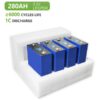
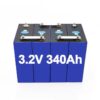
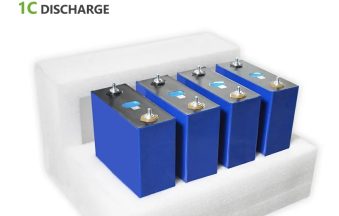
The EVE 280Ah lithium iron phosphate cell from Jule PowerTech Co., Ltd. offers a nominal capacity of 280Ah and a rated energy of 896Wh at 3.2V. Its high capacity and lithium iron phosphate chemistry make it a candidate for larger battery assemblies. Understanding its specifications and integration requirements will help you determine whether this cell fits your project.
EVE 280Ah LiFePO4 Battery: Key Specifications
The EVE 280Ah cell combines high amp-hour capacity with a nominal voltage of 3.2V. Rather than functioning as a complete household battery, it serves as an individual cell that can be integrated into a properly engineered battery pack.
Technical Specifications
| Parameter | Specification |
|---|---|
| Cell manufacturer | EVE |
| Battery chemistry | Lithium iron phosphate (LiFePO4) |
| Nominal capacity | 280Ah |
| Nominal voltage | 3.2V |
| Rated energy | 896Wh |
| Charging voltage | 3.65V ± 0.05V |
| Charge termination current | 14A (0.05C) |
| Discharge termination voltage | 2.5V |
| AC internal resistance | ≤0.25mΩ |
| Cycle life | Over 6,000 cycles, as stated in the product information |
| Capacity retention | More than 80%, as stated in the product information |
The rated energy is calculated by multiplying nominal capacity by nominal voltage: 280Ah × 3.2V = 896Wh. Actual usable energy depends on operating conditions, discharge limits, system efficiency, and battery configuration.
The stated cycle-life performance should be evaluated alongside the manufacturer’s test conditions, including temperature, charge and discharge rates, and the defined end-of-life threshold.
Why Choose a 280Ah LiFePO4 Battery Cell?
A high-capacity LiFePO4 cell can help simplify the design of energy storage assemblies when the application requires substantial energy capacity and consistent cell performance.
Key advantages include:
- High capacity: The 280Ah rating supports energy storage designs that require substantial capacity per cell.
- Thermal stability: Lithium iron phosphate chemistry offers favorable thermal stability compared with some other lithium-ion chemistries.
- Long cycle life: The product information states more than 6,000 cycles with over 80% capacity retention. Confirm the applicable test conditions before using this figure for financial projections.
- Low internal resistance: The specified AC internal resistance of ≤0.25mΩ is a useful parameter when evaluating electrical performance.
- System flexibility: Multiple cells can be configured into a battery assembly with suitable voltage, capacity, protection, and monitoring.
However, these benefits depend on correct cell matching, thermal management, electrical connections, and battery management system (BMS) configuration.

Applications of the EVE 280Ah LiFePO4 Cell
Home Solar Energy Storage
If you operate a residential solar installation, a 280Ah cell can form part of a larger battery bank designed to store excess solar generation for later use. The final storage capacity depends on the number of cells, series and parallel arrangement, and permitted depth of discharge.
Commercial and Industrial Energy Storage
Businesses can evaluate high-capacity cells for stationary energy storage projects, including renewable energy integration and load management. Before selecting a configuration, assess the required discharge power, daily energy consumption, installation environment, and backup duration.
Backup Power and Telecom Systems
Battery assemblies using these cells may support backup power designs where dependable energy availability is important. Engineers should verify discharge capability, redundancy requirements, environmental conditions, and compatibility with the intended equipment.
Electric Vehicles and Off-Grid Systems
The cells may also be considered for appropriately engineered electric vehicle or off-grid battery systems. However, suitability depends on the required voltage, current, vibration resistance, protection strategy, and applicable vehicle or installation standards.
EVE 280Ah Cell vs. Complete LiFePO4 Battery Pack
Understanding the difference between an individual cell and a finished battery pack helps you avoid purchasing the wrong product.
| Comparison | EVE 280Ah Cell | Complete LiFePO4 Battery Pack |
|---|---|---|
| Nominal voltage | 3.2V | Depends on pack configuration |
| Rated energy | 896Wh per cell | Depends on pack voltage and capacity |
| BMS | Requires system-level integration | May include an integrated BMS |
| Installation | Requires pack assembly and engineering | Depends on the product’s installation design |
| Typical buyer | Battery pack manufacturers and system integrators | Residential, commercial, or equipment users |
For example, four 3.2V cells connected in series provide a nominal voltage of 12.8V while retaining a nominal capacity of 280Ah. Their theoretical nominal energy totals 3,584Wh before system losses and operating limits. This configuration is an illustration, not confirmation of a preconfigured product or approved assembly.
How to Select the Right LiFePO4 Battery Configuration
Follow these steps before purchasing cells for your project:
- Calculate energy demand. Determine your daily energy consumption in kWh and the backup duration you require.
- Confirm voltage requirements. Check whether your inverter, charger, or equipment requires a specific battery voltage.
- Evaluate discharge performance. Verify the cell’s permitted continuous and peak discharge currents with the manufacturer.
- Plan BMS protection. Confirm cell-voltage monitoring, temperature protection, balancing, and overcurrent safeguards.
- Check system compatibility. Verify charging settings, inverter compatibility, wiring, fusing, and thermal management.
- Request supporting documentation. Obtain the current datasheet, applicable test reports, warranty terms, and relevant certifications before finalizing the design.
Jule PowerTech Co., Ltd. provides LiFePO4 cells and preconfigured 12V, 24V, and 48V battery packs. Its product range and customization services give buyers options to discuss when planning an energy storage solution.
Frequently Asked Questions
1. How much energy does an EVE 280Ah LiFePO4 cell store?
Its rated energy is 896Wh, calculated from 280Ah × 3.2V. The usable energy in an assembled system will vary according to discharge limits, conversion losses, and operating conditions.
2. Can I connect the EVE 280Ah cell directly to a solar inverter?
Not usually as a standalone cell. Most solar inverters require a battery system with a compatible voltage range, suitable BMS protection, and correctly configured charging parameters. You should confirm compatibility before connecting the battery assembly.
3. Does the EVE 280Ah LiFePO4 battery have international certifications?
The supplied product information does not identify specific certifications. Ask Jule PowerTech or the cell supplier for current documentation relevant to your intended market and application rather than assuming that a particular certification applies.
Conclusion
The EVE 280Ah cell provides 896Wh of rated energy at 3.2V, making it a potential building block for residential solar storage, commercial energy systems, and backup power assemblies. When choosing a LiFePO4 battery, compare the cell’s electrical specifications, verified cycle-life conditions, BMS requirements, and system compatibility instead of relying on capacity alone.
Contact Jule PowerTech for Your Battery Project
Contact Jule PowerTech Co., Ltd. to discuss the EVE 280Ah cell, compare it with a preconfigured 12V, 24V, or 48V battery pack, and identify a suitable option for your application. Share your target voltage, required energy capacity, expected discharge current, and installation environment to help the team assess your requirements.











Add comment